Have I SERIOUSLY never posted this before? Have I not posted ANY Bioshock Music?
Huh.
Anyway, this is the main theme of Bioshock (Cohen's music is actually a really funny abberation. Basically, the composer didn't understand the directions behind composing the theme, ( it was supposed to be discordant rather than insane) He played it, and the 2K looked at eachother and went "Well, that wasn't what we were expecting, and we liked it!) The song "The Ocean on his Shoulders" mainly plays when you see Rapture for the first time.
Also, it's gorgeous. I use it as a ringtone because it's VGM (which I love) but it sounds professional (which is also great). It's the right amount of beauty and disturbing content which is perfect for Bioshock since the world is such a mix of beauty and horror.
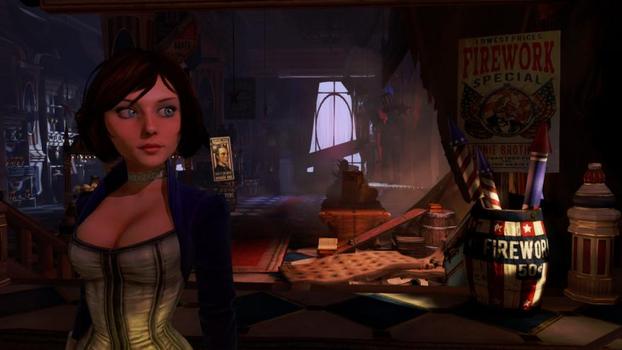
When a game has as long of a development cycle for Elizabeth, we can see how she evolves. From
This:
To This:
To the end result, this:
In addition, We also watch her evolve with her powers.
She started off as telekinesis:
then she grows more powerful by creating things out of thin air:
Later on, they introduce the tear idea, but have it include allies and the horse scene. (Neither of which happen in game)
And then her in the final game, where tears are to an alternate reality, but are in black and white. (No gameplay due to spoilers)
It's interesting to see how much has changed. The tears are a nice touch, and help make the game more interesting. The telekinesis version probably comes from the "Techie vs luddites" version of the game which was scrapped for not being interesting enough. It is an interesting idea, but I'm not sure you can extend the idea throughout the game. You could put in elements of notoriously depressing Cyberpunk, but there shouldn't have been much in 1912 US.
The tears themselves are more interesting. While they accomplish the same fact as the "Creation from their air" Aspect of Elizabeth's powers, it instead gives her a distinct otherwordly (Literally) quality. Especially because not everything from Columbia that exists in that world is from that world. It also turns her from a "Mysterious Waif" (think Namine from Kingdom Hearts) to a expertly limited powerhouse. Instead of explaining why Elizabeth can't summon thunderclouds each time you get into a fight, they basically just say "She's accessing an alternate reality where there was a water puddle there and nothing else." Which does make more sense, especially with a comment early on where she explains most realities she looks into are the same as our own, with very minor exceptions. (One example she gives is the cup has coffee instead of tea.)
Some of the realities do lead to interesting complications. (for example, a plot important building has a freight hook in it in an alternate reality. It could be in a different place, or the building may not exist.) but the idea gives a definite shape, control, and limit to her powers and prevents excessive wondering about why things aren't there and keeps the game from breaking wide open.
(In all seriousness, if you could access a reality where you could summon Subject Delta, Eleanor Lamb, and Jack Ryan at the same time, you would. The game would have to come up with an idea why you couldn't and... yeah.)
So, as I head off to finish the game and deal with, er, the subtle and excessive foreshadowing. (Seriously, I checked the Bioshock Wiki on what I thought was a minor character only to read a rather spoilery sentence. ugh.) I leave you with watching how our Elizabeth grew up.
In case you haven't figured it out, Bioshock is one of my favorite games. My love started after reading an article about how Bioshock started as a look at Objectivism and Ayn Rynd in a self contained area. Starting off in such an analytical way, we can then look at the rest of the game through both that lens and others.
Like, what exactly makes the Little Sisters and the Splicers so creepy.
The answer is very simple:
Because while they are obviously no longer human, they are still very human. When we listen to the splicers ramble, we can hear how they are scared. How they want fame, or money. We see them wearing clothes, trying not to be killed, and being honestly worried about how they and everyone else are living. Little Sisters skip around, play, and recite nursery rhymes as they pull ADAM from corpses.
In other words, they are non visual invocations of the Uncanny Valley.
What is the Uncanny Valley, you may ask?
Basically, the closer something non realistic gets to being realistic, the more unintentionally creepy it will turn out to be. Our faces and bodies make so many little movements that we subconciously pick up on, when something looks very human but lacks the little movements, we regard it (mentally) as being creepy and wrong. This is why Pixar usually uses inhuman creatures for their storytelling, and when they do use humans it's very stylized. They need to keep from invoking the uncanny valley.
Data on Star Trek, is another deliberate invocation, but he was played by a human. Tom Hanks in "the Polar Express" is a non deliberate invocation. C3P0 deliberately misses the valley entirely.
Examples:
(I can't find anything on C-3P0)
While the Splicers and the Little Sisters do not look very human (especially the Splicers) they do ACT like very aggresive humans or very innocent humans.
As humans, we can see ourselves and our friends in the splicers and we can see siblings, cousins, the children of friends, etc. in the Little Sisters.
And this is what invokes a behavioral and vocal uncanny valley. The Little Sisters act just like our own little ones. They hold on
tight, they sing, they play, it's just the fact that they drain blood
from corpses while they have glowing yellow eyes that mark them as
inhuman.
We can see how much of it is accurate. We can hear our screaming matches with family and friends, we see our greediness, our vanity, when we're terrified. We just can't shoot fire, and their outside is as ugly as our inside can be.
And THAT is Bioshock's uncanny valley. It's not the lack of breathing, or the fish that accidentally swim through the ceiling.
It's how the player knows that they are being stalked by their internal demons, and maybe kill their inner child.
If you watch Doctor Who, the idea of "You can't change history" has popped up.
If youtube cooperated, I would show you that.
However, the fact remains that games do frequently rewrite history when they take place in the real world. Let's look at Bioshock Infinite and their new trailer which has led me to this post.
Yes, I'm a sucker for Bioshock. Anyway...
Any search in the history books will reveal that while the world's fair did happen, Columbia was not involved. The Boxer rebellion did happen (it was a revolt in China against the British, Chinese Christians and other foreigners and foreign powers.) but it ended in 1901 with an alliance of western nations defeating the imperial Chinese army and taking over Beijing. It's view over history is rather complicated so we're leaving it there. However, China was very much NOT bombed in the original run.
Why do companies change the past for their stories?
Partly because it makes it easier to set in an alternate continuity. We know that Columbia didn't actually bomb the Boxer Rebellion. We know that the US won the American Revolution. We know that King Henry the Eighth created Anglican Protestantism in order to divorce his wife. These are very much facts. So when something significant changes, we take it not only as an "Alternate Universe" but because something is wrong. This is something we know is false but presented to us as true.
Bioshock Infinite had hinted at it previously.
Seeing "Revenge of the Jedi" is quite a shock.. Return of the Jedi part of our culture.
Most video games present an alternate future. It's usually a dystopian since utopian futures can get boring for a game. Fallout can be considered the main Dystopian future game that takes place in our timeline. In Fallout, a nuclear war is started over the lack of non renewable resources. In the end, civilization collapses, humanity is hanging on by shreds, and most of the rest of the world is instead heavily mutated from the nuclear fallout. I have the game on my GOG account so I'll have to play it sometime and then give more details.
An argument can be made for Command and Conquer, but it seems to heavily involve timetravel so that's both a past and future game. Again, something I need to play. According to Wikipedia, it's set in the future of an alternate timeline where Albert Einstein went back in time to kill Hitler which then led to an unchecked Soviet expansion in the 1950's.
But while Bioshock Infinite is the most obvious example, there are others. Gunparade March, Iron Storm,Resistance, and Enigma: Rising Tide are among others. (according to Wikipedia. I will admit I've only heard of Resistance.)
Gunparade is about life when Aliens invade before the end of World War II. (The historical difference should be obvious).
Iron Storm takes place in 1964 in the fiftieth year of World War I. In this world, (Looks over history) Okay, long story short a Russian General was NOT defeated and instead is trying to make a Russian/Mongolian empire and the war depends on the allied nations stock market. I need to learn more about World War I.
Resistance is again Aliens invading, but this time it's during World War I.
Enigma also involves World War I, but with the Lusitania never sinking. As a result, the US does not enter World War I so Germany takes over Britain and France.
Wars, especially the World Wars, have a dramatic effect on history and the World Wars are the most dramatic wars in recent memory. This is probably why when it comes to alternate histories, these are the defaults. Even if we don't know all the details (glares at Iron Storm) we do know that things did not end up that way.
But, no matter the reason, an alternate history gives weight to the story. We want to fix it, we want to get back to "our" history. It gives the story writers a freedom while not explaining everything and still giving it weight. The writers get to explore what could have happened if something changed. So much of history depends on near misses and oversights. What if things HADN'T come to pass. What if Amelia Earhart wasn't the first woman to fly solo. What if King Henry had stayed married to Catherine of Aragon? What if Disney stayed with Oswald?
That still doesn't mean the game will be good, but it does make it a bit more interesting.
When we left Tenenbaum yesterday, she had survived World War II by joining the Nazis for science and survival, discovered ADAM and ignored the consequences, helped create Jack with the specific purpose of overthrowing Andrew Ryan, and had created the Little Sisters in order to create more ADAM and again ignored the consequences such as increased insanity, the fact the little girls would get killed, and how Rapture was tearing itself apart throw increased emotions and super powers.
You'd think this woman is the lowest of the low and I've grown to love a villain.
It's the next part of her life that makes her fantastic. She changes.
The Little Sisters reawaken her maternal instinct and she realizes just how much she HATES herself. So, she takes a step back, reevaluates her life, and begins to change.
And by begins to change, I mean kidnap the little sisters, develop a a Tonic that allows you to remove the slug from the Little Sisters without killing them, kills any Splicer who tries to harm them, sets up a safe house in Rapture where the Little Sisters can grow up normally until she can get them to the surface, and works with the main character of Bioshock in order to beat Frank Fontaine so the Rapture nightmare can end.
And that's just pre/during Bioshock 1!
She makes her first real impression after the first boss battle of Bioshock 1. You have to be detoured through a room. When you walk in, a splicer is threatening a Little Sister, and Tenenbaum shoots him. Brigid Tenenbaum offers Jack the plasmid to save the Little Sisters. Atlas says he should kill the Little Sisters. She then offers advice and items (if you save the Little Sisters) throughout the levels as you learn more. And when you are almost killed for Plot reasons, she saves your life.
She comes up with the idea to stop Fontaine, and she gives the ending commentary.
But that is NOT the end of her journey?
Nope, because in Bioshock 2, she RETURNED to Rapture. She figured out someone was kidnapping girls to be Little Sisters again. She could have stayed where she was. She could have said it wasn't her problem.
Nope, she heads down to rapture, contacts Eleanor Lamb, the first Little Sister, and resurrects the first Big Daddy with the express purpose of saving the Little Sisters and stopping Sofia Lamb from continuing her path of destruction. (I've talked about Sofia already.)
Then, THEN, she works out a way to SAVE a Big Daddy, to turn him back to being a human (a feat thought impossible) and will use that research to find a way to...
Tenenbaum really managed to turn herself around. She's done war crimes, caused the downfall of society, rewrote the laws of nature...
and she also saw that all she did was wrong, should be corrected, shouldered the burden herself, and went above and beyond in order to save the city and the people she destroyed.
THAT is why I like Doctor Brigid Tenenbaum. She's incredibly smart, incredibly flawed, and works on fixing every problem that she caused. She hopes for a redemption she feels that she can never grasp. Who knows? Maybe she can't. She'll probably always torture herself over this.
But, the fact that she does try, and gives it her all, speaks volumes about her character. She does whatever she decides to do, and she does it with focus, with energy, and with a growing compassion.
When I started to pay attention to Bioshock, it was because of the moral issues presented in the story.
After I started to play the game, a character stood out to me. Doctor Brigid Tenenbaum. She's one of our main viewpoints throughout Rapture. She's a genius, she's a holocaust survivor, she caused the downfall of Rapture. She's working on fixing it.
We have a very flawed woman at the core of the Rapture story. And in those flaws she can explore every side of Rapture. Her backstory has her as a Holocaust survivor, but she was a bit more than that. She joined the Nazis because they offered her science and survival. Even though she was Jewish. Even though she was a woman. Even though she was trying to do genetics. And survive she did. She went along with experiments on her own people because she wanted to find out why people were the way they were. Smart, dumb, strong, weak, blond, brunette. What was genetics, how did it control who we were, and could it be changed?
And when she arrived in Rapture, it was for the same reason. Survival. A Jewish ex Nazi female scientists would NOT have done well in the world outside. The Jewish People weren't that well respected, and the fact that she was a female Ex Nazi scientist would have kept people from hiring her anyway. So, Andrew Ryan offers her another option. Survival. Survive in the underwater world of Rapture. Survive in a world where you can do your science no matter what and no one knows who you truly are. She accepts.
She arrives in Rapture and in a chance walk along the docks she discovers what will change Rapture forever. ADAM. She knows that there is a dock worker who had injured his hand in World War II. She knew that as of yesterday that man was still injured. She knows that today she is watching him play catch with the injured hand. He gives her a slug, and she begins her research. This is her way to survive here. In the world of Rapture, your life is dependent on how much and how hard you work. She doesn't run a shop, she doesn't work in a hospital. Her job is to do science. That may not always pay. Especially when you are a female scientist in the strange and new world of genetics. So, she goes to Frank Fontaine. The man with the money. The man with the ties. The black market man. More importantly, money is survival. It's her way to work in Rapture, otherwise, she'll be ignored and beaten by the masses again. Like always, she chooses survival.
And, eventually, chooses her own. She makes the discovery of several lifetimes. ADAM. Something that can rewrite anyone's genetic structure. Something that can fulfill her wildest dreams. It also causes physical degregation, insanity, increased rage, and addiction. She still goes through with it. She gets her money, Fontaine gives her protection. She, as always, SURVIVES. She survives at the cost of Rapture, at the cost of the little girls.
Yes, the Little Sisters. she creates them. ADAM is starting to run thin, the insanity is starting to break out so they have these ADAM filled bodies. And Tenenbaum figures out that putting the slug that creates ADAM into a young female hose will cause it to yield three times the ADAM when the host ingests it. It guarantees her job, so she tries to perfect it. She is probably involved in the Big Daddy side of it, where they turn political prisoners into mindless and ADAM drenched beasts. It guarantees her survival.
Until she spends just a BIT too much time around the Little Sisters. When she finds people who love her no matter what she's done. People who will probably die soon because of how she put survival before everything.
She changes then. Slowly, but significantly, she begins to unwind her ideology and begins to put the other children first.
What goes unmentioned is how PC gamers need to pull that off. Namely, they have to invest in higher end PC's or build their own. While I have no problem with that, I do have a problem with the continual investment. In order to play games so they look their best, you must always have the top of the line PC. And this level is constantly increasing. When I bought Psychonauts off of GOG for my laptop, it was unplayable due to my processor not being up to snuff. 4 years later, my standard House PC can play it fine. There's no stuttering, the images are smooth, and I can finally enjoy it.
With a Console, you make a one time investment. Okay, you could upgrade every six years or so, but at that point things will have improved dramatically. Here is Castlevania on the NES:
Here it is on the SNES:
Here is the N64:
And now, I'm skipping to the PS3/Xbox:
Will the PC version look better? Probably. I'm not denying that point. Do I play PC games? Yes. I love GOG.com and when I can bust out steam, I do.
But, in the end, does the particle effects truly effect the story? No. Will it effect your ability to play the game? Nope.
Someday, I may invest in building my own PC that I can upgrade. Steam and GOG has quite a few exclusive games I do want to try. I learned how to play chess thanks to Lego Chess, which has no Console equivalent. The mods for PC games can be fantastic and it's a lot easier to find deleted content with a PC than it is with a console.
But until then, I'll be quite happy with my portables and my consoles. It gives me exactly what I want to do at a less, overall, cost.
(SPOILERS FOR MASS EFFECT 3, BIOSHOCK, AND FINAL FANTASY 7 ENDINGS AHEAD!)
Still here? Great!
If you have been following gaming sites since Mass Effect 3 was released, you should have noticed something. Namely, people are complaining about how no matter what you choose up to that point, Shephard blindly accepts 3 options and each have stock endings.
Admittedly, there are a few minor differences between the three endings, but all in all, they are the same.
However, I was thinking, if the choices were more limited -or the choices were generally acknowledged to have no effect on the endgame- would there still be the complaints?
Bioshock (and Bioshock 2) had several endings, but these all varied on your choices up to that point.
Unlike Mass Effect, these are your only choices in the game. In Mass Effect, almost every bit of the story depends on your choice and your reputation (Paragon, Renegade, etc) In Bioshock, you can save or harvest Little Sisters. That is the only time you are given a choice. (One exception is granted for if/when you kill Sander Cohen, but that has no effect on the ending and it isn't set up as a choice like the Little Sisters are.)
In Bioshock 2, the Little Sister choice survives, but you are also given a choice on how to deal with many of the "Boss" characters. You can kill or save people like Grace Holloway and Stanley Poole. They are not attacking you, but they have offended you or betrayed you. If you choose to spare them that also has an effect on your ending.
When the ending does come around, Eleanor spells out why she is doing what she is doing, and names your treatment of the Little Sisters and people like Grace as shaping her philosophy on life. While the choices are limited, you do feel like they have some effect on the ending.
(2K has admitted to dropping the ball on the Bioshock1 ending by making it an "All or Nothing" type of ending, but the end result still applies. Killing the Little Sisters gives you a worse ending then saving all of them.)
In Final Fantasy 7, you can make several (non gameplay) choices through out the game, but all of them are minor.
1) Your party when you enter certain areas. The only thing you miss is character reactions. They may give some additional backstory, but no matter what, the story still continues unchanged.
2) If/when you recruit Yuffie. This only effects the availability of one side quest (possibly two. I don't know if the Turk sidequest is triggered if she is not in the party), her weapons, some late game materia (as prizes in the sidequests), character chatter, and she has a Gold Saucer date with Cloud.
3) If/when you recruit Vincent. Except for the Gold Saucer date, his effects are the same as Yuffie's.
4) What you do during the flashback in Kalm. When Cloud's party arrives in Kalm, he starts to narrate the story of how Nibelheim was destroyed. This flashback is not mentioned again until Sephiroth starts to tear apart Cloud's psyche. When he does so, Cloud lists what he did in Kalm. Other then what is necessary for the plot (such as visiting the mansion) everything else is dependent on choice. (So, yes, Cloud can boast of stealing Tifa's bra.) This flashback is only mentioned once again, but the choices in it are not mentioned.
5) The second to last Sephiroth fight. Like Bioshock, this is based on what you did previously. Whether or not you recruited Yuffie and Vincent, what level you are at that point, if you picked up the strongest materia, how quickly you beat the final Jenova, and if everyone knows their final limits all influence which version of Bizarro Sephiroth you face. The general idea is the same, but how you defeat him slightly varies. (If you fulfill most of the requirements, he has more HP and he has a more complicated pattern to beating him.) This choice has the most effect on the ending, but it is still simply one of the final boss fights. This does not effect the story in any way, nor does it effect the ending.
6) The Actual Golden Saucer date. Much like Bioshock, your date is picked based on how you treat the other characters during the game. Unlike Bioshock, this has absolutely no effect on the ending.
As a result. there is only one ending.
No matter what you chose, no matter who is in your party, you get that ending. (Admittedly, this is partly due to the fact that SE could not program the four endings that would be required to deal with Yuffie and Vincent, but the point remains.)
So, getting back to Mass Effect...
One of the main issues is that your choices through out the three games are completely abandoned when it comes to the ending. (Other issues include the copy and paste ending, the lack of dialogue, and plot holes.)
If the game had made it clear your choices would not have effected the ending - such as Final Fantasy 7 - or shown how they effected the ending - such as Bioshock- would Mass Effect 3 still receive the complaints?
I'm pretty much the only person who hasn't played Minecraft yet. Looks quite interesting though. When I get the chance (and my computer can handle it) I'll give it a try.
Please understand that like all I've done, this... is an act of love."
Sofia Lamb is the villain of Bioshock 2. Much like Andrew Ryan, we never fight her. Unlike Andrew Ryan, her death is entirely due to our choices in the game. (See here for more information)
Sofia Lamb is never mentioned in Bioshock 1, but plays a large part in it's backstory. Before Rapture, she worked as a psychiatrist. She grew up under her father, a physician who believed in a "Triage" philosophy. Namely, things should be done for the greater good. Later on, she worked in Hiroshima as medical personnel during World War II. While she survived the bombings, her friends did not. Around this time Andrew Ryan came to her. She believed the world was going to Hell and was in the process of destroyingitself, so she accepted his offer and joined him in Rapture.
In Rapture, she began to make a name for herself. She offered free psychiatry sessions to the poor, intentionally lost poker games so the person with the most to gain got the money, and set up a place for artists to work. While these would normally be good things, things quickly escalated due to the interference of Andrew Ryan. Andrew Ryan believed that the harder you worked, the more you were rewarded. If you had trouble financially, it was your fault and you should suffer for it. In addition, he had no use for art. Andrew Ryan arranged debates to weaken her position. But in the increasingly stifling atmosphere of Rapture (due to Fontaine, the discovery of ADAM and it's side effects) Andrew Ryan instituted rules and methods that were increasingly draconian and betrayed his ideology. During this time, she took genetic material and had a daughter.
(watch Eleanor's Progress, but the other videos do explain her ideology.)
Her supporters began to organize into a religion, and since religion was illegal in Rapture, Ryan arrested her. He made evidence of her existence disappear, but the poor never forgot her.
In 1958, she escaped from the prison colony "Persephone" and used the confusion of the attack on Kashmir Restaurant to take back her daughter, Eleanor, who had turned into the first Little Sister. To do that, she had splicers sacrifice themselves so that Delta would be hit by a "Hypnotize Big Daddy" plasmid. She then ordered Delta to shoot herself in the head in front of Eleanor
Eleanor is taken back to Persephone and injected with ADAM so she can possess the entirety of Rapture in herself. Everyone's thoughts, memories, powers, Lamb believed that her daughter was the "Utopian" who could possess everyone within her. She would work only to help other people, she would be compelled to.
As Delta journeys through the game, he finds out things about Sofia Lamb. She murders anyone who attempts to flee Rapture. She uses both the Splicers, rogue Big Daddies, and Big Sisters as weapons. As long as their ADAM is returned to the cycle, she does not care about what happens to them. She kidnapped Mark Meltzer and turned him into a Big Daddy. She also kidnapped an unknown number of girls to become new Little Sisters once the old ones grew up and became crazy.
In the end, she smothers Eleanor because she knows that will slowly kill Delta (therefore he will be unable to revive) and then she detonates Persephone because she realized that she failed.
In the end of the game, Eleanor uses the freedom of choice that Delta gave her to either forgive Sofia, ignore her death, or actively murder her
What do we know?
1) She originally started out as a good person. "The Greater Good" is something that has been desired for years. She sincerely wanted to help people when she arrived in Rapture. Her ideas were good, but Rapture sickness gets to everybody and she very quickly went to the absolute extremes
2) She's uncaring. All Mark Meltzer wanted was to be with his daughter. All other people wanted was to escape. She denied all of these. She ordered Splicers to go on suicide missions to stop and/or control Delta. She turned Sinclair into an Alpha Big Daddy against his will. She suffocated Eleanor Lamb. She does not care about other people.
3) She does not care about choice. What Bioshock 2 emphasizes throughout it's gameplay and story is the ability for people to choose their fate. Mark Meltzer did not get much of a choice, but he still chose. Sofia Lamb eliminates all major choice from life. Instead of asking if Eleanor wanted to be the utopian, she forced it on her.
People often despise Sofia Lamb more then Andrew Ryan or Frank Fontaine. It's not due to love of capitalism. Instead, it is the horror at how she twists something so good and turns herself into a villain.
So let's talk about what first made people sit up and take notice of the game.
The game's opening
It's been a few years, but it still is quite stunning, and in less then then minutes we are not just suspicious of the world but we know for a fact that it will try to chew us up and spit us back out.
Let's get started!
We start off with a date, 1960. This should immediately relax us. It's in the past, we shouldn't have to worry about any high tech weaponry. We see that we're in an airplane. Well, unusual but our PC is fine. The tattoos are a bit odd, but he's got a picture of his family in his wallet and a present. It should be all okay. We get a suspicious voice over, then turbulence.
When we wake up, we're underwater. We see debris fall until we come up to the surface and we realize one thing. We're probably the only survivor. The game herds us towards the lighthouse. The fire blocks off the other paths and it's the only significant thing that we can see. While this is all odd, it's not really unusual for a game. We don't start getting really disquieted until we see the slogan in the obscenely ornate hallway.
"There are no gods or kings, only men"
It's an interesting idea, not unheard of, but it's still disquieting. What's more disquieting is why is there a gold head in a lighthouse in the middle of the ocean and why is does it have THAT in it's hands. Unnerving, but let's continue.
We enter a Bathysphere which is still unusual and enter into the actual world of Rapture.
Something we should note is that before we see Ryan's speech, we see a commercial for INCINERATE! Plasmids. It's a little detail, but it's a hook into the commercialism focused world of Rapture. In their world, only the rich succeed. It is also holds two clues that getting out will not be as easy as it seems. 1) (obviously) we're in a bathysphere going deeper underwater. We don't know how we're going to escape. 2) Whoever lives where we're going has developed the ability to shoot fire from their fingertips. If nothing else, it's a warning.
Then we get to the famous part, Ryan's speech. (Video is speech only)
The first part, about whether a man is entitled to the sweat of his own brow, is phrased in a way that we should say "YES!" We've done our share, we want our due. But there is always something slightly out of tune. Is he suggesting abandoning the poor, God, and everyone else and only focus on ourselves? Or is he saying that we should work on our own due? However, it's all swept under the rug as we finally get to see the world of Rapture.
It's a beautiful place. It's a working city under water! But as Ryan keeps on talking, things turn slightly sinister. Specifically, the line "Where scientists are not bound by petty morality". Please keep in mind that this speech was probably made right after WWII, when the horrors of Auschwitz were revealed. By having something not be bound by "Petty Morality" scientists could do whatever they wanted. While it could lead to amazing breakthroughs, the price could be too high. It would also allow for other experiments to go through, items like mind control, methods of genocide, and so on. With nothing to hold scientists, back, what would they pursue? And how would the great not be constrained by the small?
But, we're not really listening. We're too enraptured by the sights below. We see whales, and someone in a diving suit sealing a tunnel, and there still is the fact that massive buildings are thriving here under the sea. All of our previous worries are washed away by the scene. Then the sense of uneasiness returns.
There is someone on the radio. That's good, we know someone else is alive. Two other people, actually. They are discussing our arrival, apparently it's impossible that we should have arrived, the plane was destroyed and we are in the middle of the Atlantic ocean. Well, that's fine, but then we hear a word. "Splicers". We get no context, other then the non Irish guy should be quick since the Splicers are coming. As their conversation ends, a light goes out on the signs. While the place feels a bit abandoned, we're under water. It's natural that no one is around. But the lights crackling out like that gives us back our sense of foreboding. Coupled with the talk of "Splicers" we know it's not good.
Every ounce of assurance vanishes once we actually arrive in Rapture. There is someone out there, someone who we heard on the radio. And as we watch helplessly from behind the glass, the man is torn apart by hooks before that creature sets upon our ship. Obviously, we know that whatever Rapture was SUPPOSED to be, has failed. We don't know why, we don't know how, but there is at least one crazy hook handed person wandering around killing people. Whoever it is is also deformed. We could see lumps and bandages from the brief flashes of light. Any suspicion of it being only one person vanishes when we hear Atlas talking about "Aiming to keep you alive" there's still trouble out there.
As we exit, we can see placards on the ground. "Rapture is Dead"
While there is a lot to be said about the rest of the level, I'll just leave it here for now. What do we know?
First, it's impressive. Seriously, props to the programmers. We have fish, squid, a whale, the outside of an entire city, and we are moving through it all. It's only a few minutes but it's really impressive on a visual and technical level.
Andrew Ryan is charismatic, intelligent, and selfish. He has built and entire functioning city underwater, he has apparently convinced enough people to forsake everything up above to live underwater -if the fact they have built a waiting area and recorded an intro video for a bathysphere is anything to go by- and his speech is all about the serving of one's self. It tastes a bit of a cult of personality, but only enough to unnerve the listener, not actually scare them away.
The city used to be well run. Running a city is hard, running a city underwater is even harder. The city is huge, is full of lights, and they are still up keeping the city, but it fell apart not due to outside forces, but inside ones. Luggage and "Rapture is Dead" signs are not notes of an invasion, but rather of political controversy. We don't know what happened or who won, but just one crazy hook handed person can not be the sole cause for the city falling apart. The person, probably a splicer, unnerves us but whatever else is out there is worse, or at least there is more of it.
We still go on, but we are stuck with the two dichotomies presented in the opening. Yes, it looks amazing and it's impressive on a purely technical level, but the inside is completely rotten.
There is a reason why Mark was a late addition to the game... (Bioshock 2 Spoilers)
Mark Meltzer was created for the Bioshock ARG called "There's Something in the Sea" He was an unknown character at first, just someone filling in a map. The map has news paper clippings, photographs, and notes talking about the disappearances of several little girls who fit a certain profile.... ages 5 to 7 with dark hair. Late in phase one, we find out the person who filled in the map just lost his own daughter to the monster, and we find out his name is Mark Meltzer.
Mark is revealed over the story to be smart and dedicated. He's being threatened by a mysterious force over the story and as a result he loses his daughter, his wife, and his status. He has friends in odd places (such as the National UFO society) but by looking at unconventional data he managed to pull together a picture of the disappearances. Either as a threat or encouragement, the Big Sister who threatened him may be the one who is leaving him clues.
He receives a record, puzzle boxes, and drawings from a mysterious place underneath the sea. Above the sea, he finds information about people who just disappeared after world war two (such as Andrew Ryan, Dr. Suchong, Dr. Tenenbaum, Sander Cohen... the citizens of Rapture) and maybe where Rapture existed. The information and it's sources get more and more outlandish, but there can be no denying that the information fits. Eventually he makes his way into Rapture.
Once he arrives there, he gathers information about the Splicers and about his daughter.
We lose his audio diaries, but he fills in important pieces of the puzzle. And then we learn his fate.
So, what do we know about Mark?
He's incredibly loving. He was worried about a series of disappearances. He had nothing to do with the vanishings, but he looked into them anyway. When he lost his daughter to The Big Sister, he didn't give her up as dead, he looked even harder.
He's devoted and determined. Mark searched for months. He lived through revolts, mental institutions, assassination attempts, puzzles, Splicers, and Big Sisters in order to get Cindy (and the other girls) back. The only reason he stopped looking is because he found her. Which then lead to him being captured, but that is because relief dulled his senses.
He's human. Through the letters and phone calls we find out about a very devoted man. He has friends, family, interests... we don't see that in Rapture. People are usually very extreme and violent due to ADAM splicing, but he has none of that. He occasionally fights back in Self Defense. He doesn't have a madness mantra. We see him leaving his hat around his apartment, we hear him worry about money, we read about how he was tricked or how he went down the wrong path in his search, we notice how he keeps photos of his family around. We may not know all of his little quirks, but it is enough. We root for him because we see that he is, entirely, human.
He's clever. First, he manages to FIND Rapture, a city in the middle of the sea who's location has been hidden for years. The clues are scattered and obtuse, but Mark puts them together and actually discovers Rapture. Jack and Delta also found Rapture, but Jack was manipulated into finding Rapture and Delta's outside Rapture status is only hinted at in a conversation that calls him "Johnny Topside" Both Jack and Delta found Rapture years ago. Mark found it in 1968. The developers stated that the enemies of Bioshock 2 would be more powerful. Jack (the Player Character from the last game) would probably die if he entered into Rapture now. Jack, canonically, gets at least one splice and quite a few weapons. Mark has... a pistol. That's it. He has to think and plan his way through Rapture in order to avoid Splicers and find Cindy. And in that he gets about half way through Rapture and the only reason the Big Sister surprises him is because he's in shock from seeing Cindy.
And then we get right back to loving. Between losing his identity to protect Cindy or simply dying, he chooses to be with Cindy.
Not bad for a character who isn't supposed to exist.... Well, originally. During the "There's Something in the Sea" viral campaign, Irrational Games revealed Mark's address. People started to send him fan letters. The campaign became more interactive because of the support and Mark was put into the game, along with Cindy. (due to time constraints, Cindy's model doesn't have blond hair and a planned trophy for rescuing Cindy was cut) When Mark was put in, originally he was to follow Delta but the final product had it the other way around.
Mark is one of my favorite characters. He's loving, devoted, determined, and tragic. There's a reason why fans were devestated to find that Big Daddy they just killed was Mark, and the Sister is Cindy. He was something you don't see in Rapture and we loved him for it. He was a devoted, human, father.
Apparently, this was more then a tease for the new ad campaign.
This was, apparently a tease for an ENTIRE GAME.
Yes, Ladies and gentleman, if the rumors are true then Sony is making a Smash Brother's style fighting game that is tentatively called Title Fight.
You can read the rumors here: Title Fight. The page notes that the "Michael" ad was a tease for the game. Here is IGN's Rewind theater that notes the games in the ad.
(I like Rewind Theater's and they can point out more things then I can)
So, IF the rumors are true (and I have no vids to speculate on gameplay) Who do you want to be in it?
Final Fantasy HAS to be represented as it is considered a "Sony" type game recently (All the main titles from 7-12 not including 11 were PlayStation exclusives. 1,2,4,5, and 6 were rereleased on the Playstation and with Dissidia all main games have had characters released on a Sony system) But which hero? I think it would boil down to between Cloud and Lightning. Cloud is iconic and SE has been promoting Lightning lately. Lightning would have more variety (Switching between Commander (Physical), Ravager (Black Magic) and Medic (White Magic) in Dissidia for example) and she has Odin, but Cloud is a normal swordsman and is probably more popular and iconic. Lightning is a bit more over promoted but still a viable choice.
Sly Cooper is in there,so why not Cole from InFamous? He's a really good option for fighting games. He's going to be in Street Fighter X Tekken!
No, really, he's going to be in Street Fighter X Tekken.
So, first player, fighter, he's looking like a good choice, if Sly wasn't already in the game.
Ezio isn't an exclusive character, but he was in the trailer, has a good fighting set up, and is going to be in Soul Calibur V, so he's also a viable option.
Subject Delta from Bioshock 2. Again, not completely exclusive but would be a VERY powerful "Tank" option. Between the plasmids, guns, and iconic drill he could do quite a lot in a fight. Plasmids would probably drift to the more offensive ones. (INCINERATE! Electrobolt, Winterblast, telekinesis, etc) the downside is he can't really talk... but it would still be cool. (While Delta does not appear in the trailer, the Little Sisters do)
Snake from Metal Gear Solid. Much like FF, MGS is a third party series tied to the Sony brand.Snake has a large role in the trailer and has already appeared in a fighting game. Unfortunately, that game is Super Smash Brother's Brawl. While it CAN be done, (he's very good in Brawl) I'm not sure of the legalities.
Ratchet and Clank from... Ratchet and Clank. Playstation Exclusive characters, would compliment Sly Cooper well, lots of gadgets to play with... would be a very fun choice! (Plus Ratchet was in the trailer)
Ico or Wander from Ico/Shadow of the Colossus. I honestly don't know too much about these two, so I can't say much.
Dante from Devil May Cray. So, yeah, talking about White Haired Dante here. Lots of variety, devil may care attitude, would be a good way to mix up play. He was JUST in (Ultimate) Marvel vs Capcom 3 so I don't know if there would be legal issues, but there might be. (Character is exclusive, company isn't)
Ryu from Street Fighter. I don't think I have to explain why.
That's all I can think of right now, but I'm afraid I'm going to have to shoot down Chell. I ADORE her, but she doesn't have much fighting potential and Valve is considered more of a PC company then a console company. Plus, until recently, Gabe Newell hated the Playstation for some reason.
And while the three heroes from Trine would be another good option, it's a downlodable multi platform game. it doesn't feel quite right. Would be fun to switch between all of them though!
I was inspired by this IGN editorial yesterday:Editorial: Shock Without The Awe and it got me thinking about violence in video games. (note: I have not played Modern Warfare 3, so I am taking my information from the editorial)
I'm not going to argue "all violence desensitizes us to real violence" or "It's all fake so it doesn't matter" That is a VERY thorny matter, and one I've bumped heads with alot. I'm going to be looking at something else.
Justified violence.
When do we see violence in games and how does everyone react to it? Is it just there to drum up controversy or does it mean something more.
First: I'm going to look at one of the most famous scenes in video games. (Final Fantasy 7 spoilers)
Yep, Aerith's death. Something that traumatized more then one generation of gamers. You may ask: Why was it put in there? She didn't sacrifice herself heroically to do something, in fact, she may not even had needed to die at all!
That was the point.
Yoshinori Kitase was the director and co writer of Final Fantasy VII. During his work on the story, his mother died. While they had known they were going to kill off one of the characters for a while (It boiled down to either Aerith or Barrett as they were the only other characters besides Cloud created at that time) the circumstances around the death dramatically changed.
They were annoyed with the Hollywood cliche of "sacrifice to save others" and when Yoshinori Kitase's mother died, he realized his own way of coming to grips with his mother's death and how to make the death meaningful in the story.
"In the real world things are very different. You just need to look
around you. Nobody wants to die that way. People die of disease and
accident. Death comes suddenly and there is no notion of good or bad. It
leaves, not a dramatic feeling but great emptiness. When you lose
someone you loved very much you feel this big empty space and think, 'If
I had known this was coming I would have done things differently. These
are the feelings I wanted to arouse in the players with Aerith's death
relatively early in the game. Feelings of reality and not Hollywood."
Tetsuya Nomura also stated:
"Death should be something sudden and unexpected, and Aerith's death seemed more natural and realistic." "When I reflect on Final Fantasy VII,
the fact that fans were so offended by her sudden death probably means
that we were successful with her character. If fans had simply accepted
her death, that would have meant she wasn't an effective character. "
(Quotes taken from the Final Fantasy wiki page on Aerith's death)
This death meant something to the player because it was so random, so unexpected, and so violent. (I do not like Aerith that much(and I knew about her death), but even I was shaken up by her death and I had to take a break when playing it. I'm still very glad that it hasn't yet been made into a HD scene for Advent Children or a PS3 FF7. The closest we've gotten was the seconds before in Advent Children during a brief glance into Cloud's thoughts) and it spurred the characters on. They fought to avenge Aerith and save the world.
Now, bizarre as that may seem, that is a positive portrayal. How about a negative one? (Bioshock 2 spoilers)
Bioshock 1 had set up the expectations of morality but they weren't really fleshed out. (Even the developers admit it) This was fixed for Bioshock 2. This ending is a punch in the gut.
During the game, you see the line "Lamb is watching" all over Rapture. Eventually it is revealed to refer to two characters, the antagonist "Sofia Lamb" and her daughter and your Little Sister, Eleanor.
Eleanor spends the game watching what her "Father" does. But you don't truly grasp that until the end of the game. Your ending is decided upon two factors. How you treated the various non threatening bosses (such as Grace Halloway, Alexander the Great, etc) and how you treated the little sisters. If you had a tendency to forgive and allow the bosses to live, Eleanor saves Sofia. If you both killed or saved, Eleanor lets Sofia drown. If you kill the bosses, she kills her mother. For the little sisters, how you interacted with them deals with if/how Eleanor takes your ADAM. Saving them has Eleanor take your ADAM as her conscious, mixed saving/killing leaves Eleanor confused and waits to see if you will let her take your ADAM. Killing the little sisters has her take your ADAM by force.
Bioshock 2, like Modern Warfare 3, does not dwell on the analysis of these actions. It literally does not have the time. Subject Delta is dying and how his life ends is how it ends. He can not change what Eleanor has become. As a result, some players may not realize what they have done to Eleanor until it is too late. It is very effective because there is little post action analysis. This is different from the Modern Warfare 3 example All the analysis is before. The entire game is about free will. In playing for themselves, players may not realize the little girl they have corrupted.
I'm with the article. More analysis like this can help show what games can actually do for the sake of art. There will be crap, not all art or literature is classic, but if enough gems shine through, our hobby can actually get respect.
Bioshock is one of my favorite games,so I'll be visiting it a lot. I just want to talk about what makes it one of my favorite games.
The design of it's world.
We're going to skip over the (FANTASTIC!) opening right now and skip to one of the earliest levels, the Medical pavilion. (Note: this game is rated M for a reason. A large chunk of the reasons can be seen below)
The opening level is very good at setting up the game. We hear about how the world has gone crazy through ADAM. We fight Splicers. We see Big Daddies and Little Sisters for the first time.
The Medical pavilion is the first time this all comes together. First, though, there is the shock that all of this is happening in a medical pavilion, a place supposedly devoted to healing. We have secretaries murdered behind desks, splicers attacking eachother in the halls, and Steinman's little "Dioramas" all over the place.
One of my favorite parts of Bioshock is very rarely are items placed randomly. Teddy bear on a wheelchair? There were kids here. Dead splicer with luggage? She was trying to escape the medical wing. Splicer sobbing over a small casket? A baby died. If you actually pay attention, it really helps in telling a story. (I wasn't, though. It was my first shooter and M game and I was mostly "Oh, gosh, thatthingischasingmeandithasagunsmashattackbuttonsmashattackbuttonshootthethingohnothereisanotherone-) Some items are for shock, others are for terror, and others are to tell a story but each item DOES mean something.
Then there is the actual scenery. The floor, walls, and ceiling (along with various aesthetic touches like plants and benches) are very rarely whole. The floor is ripped up, walls are broken or painted on, and water leaks from the ceiling. They can saw "Rapture is a mess" or they can show it with these items.
Admittedly, Welcome to Rapture has some of these items, but they don't have the same effect due to one thing. "Welcome to Rapture" lacks a boss.
Meet: Dr. Steinman
Dr. Steinman is mentioned by Atlas early on and gets an Audio Diary talking about how ADAM has improved the medical process. However, we don't go "Oh Crap" until we walk into a room and see "Above All, do no harm" apparently written in blood (or red paint to imply blood) with cut up photos of women around and an audio diary offered up to the viewer. We need to get past Stienman in order to survive and he makes it quite clear that the medical pavilion is HIS. Splicers have made a point in their delusion to warn that "Steinman kills" and as time goes on, we see why.
He quite clearly has been sampling ADAM in his audio diaries. He consistently talks about the need to be beautiful and how ADAM accomplishes that. As the macabre temples to beauty continue he explains how not only has he seen Aphrodite (the goddess of love and beauty) wandering the halls, he's had lunch with her while discussing beauty. (result? Picasso made the most beautiful people)And then he believes that beauty is a moral imperative, turning both incredibly shallow and incredibly terrifying.
Why is this important? While we have heard, repeatedly, that ADAM can cause insanity, we have never actually seen the effects. Yes, we've seen splicers but they mostly just say the same phrases over and over so while they say SOMETHING when they attack, we don't really know how they got there. Steinman is different. We watch his fall through his audio diaries and we are helpless to do anything. Rapture hadn't been defaced by anything like his murals before we come across them the game. We have never had a splicer deliberately work against us and plan against us. And bosses don't usually have this amount of set up unless it's something like the final boss. (At least, the bosses I have run across don't. I don't claim to have played every game ever so I may be wrong)
And then we get this.
There is a reason that Steinman is my scariest moment in Bioshock, or in any game ever.
If it was just a moment it would have been more random. But due to the careful amount of set up, we are properly terrified. He is not an aberration in a shooter, he is not a typical splicer that we can run across. He is the leader of the medical pavilion and the boss of the level. He comes across as powerful. He has made it clear he will not tolerate anyone ugly. He is going to kill us.