Showing posts with label Gender issues. Show all posts

Wednesday, May 15, 2013

Why being a Princess isn't a bad thing.

So, as Merida is formerly introduced to the Princess Line at Disney, she received a hand drawn make over.  In case you didn't see Brave, Merida was Pixar's first female heroine.  She loved her family, was unafraid to speak her mind, and preferred the outdoors to "Womanly" pursuits.  (This article will have heavy spoilers for Brave and other games.) 

I'm not here to talk about the actual design change.  I'm sure some of it was simply because hand drawn and CG vectors are two different things.

I'm going to talk about what went on around it.  This IGN article discusses Brave, and then goes on to mention how the original Disney Princesses were terrible role models for young girls.

I actually take offense at that.  These girls are great role models, and so are other gaming princesses.

Yes, I'm bringing Kingdom Hearts into this, but I'll look at others too.  

Looking JUST at Kingdom Hearts (and the sequels/spin offs)  Let's look at the Disney princesses.

In Kingdom Hearts, there are seven Princesses of Heart.  Snow White, Cinderella, Sleeping Beauty/Aurora, Alice, Belle, Jasmine, and Kairi.  Ariel also appears, but is not a Princess of Heart.  Wendy, Mulan, Meg, Queen Minnie, Jane, Tinkerbell, Elizabeth, Daisy, Esmeralda, and Quorra also appear.  Then we also have Aqua, Xion, and Namine who fit into their own category and are not Disney.

Almost all of them have had their movie story told, but in stripped down format.
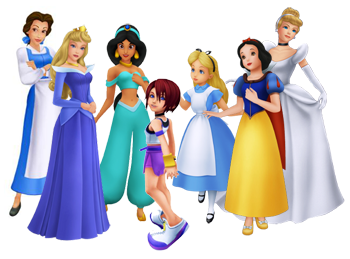


With Snow White, she generally does react to situations, and she does fall asleep, but she also takes what she can into her own hands.  No, she doesn't know that the Evil Queen is out to kill her.  She, however, is aware she is in danger and the dwarves offer her a safe space.  In addition, she offers hospitality by taking care of them.  The story's true love aspect in KH is an afterthought.... mostly because the Prince appears in the last bit of Aqua's story.  Snow White understands she is in over her head, but she reacts with aplomb by controlling what she can and never becoming vengeful. 

Cinderella is a hard and cheerful worker.  She puts hope in her dreams, but her dream was to have a good time at the ball.  Falling in love was second. She's kind, she rescues Ven.  But she also allows herself to have emotions.  When Terra finds her, she's broken down because her wicked step sisters tore her dead mother's dress to shreds. 

Sleeping Beauty: Okay, fine, she's asleep for all of Birth By Sleep and most of Kingdom Hearts.  But look who picks up the slack.  The three Good Fairies and Maleficent.  We can't blame her for being cursed.

Alice: for the little we see of her, Alice is trying to make sense of what is going on.  Unfortunately, she is in a land that flat out doesn't.  So, she orders Sora around (well, Sora partly offers)  and instead of just going with the flow, she fights that what is going on because it IS unfair.

Belle:  She got her chance to shine in KH2.  She knows something is wrong with Beast, and she fights what she can.  While she does get kidnapped, she uses her cleverness and wits to save the day.  Namely, she elbows Xaldin to save the Rose.  To get the full context, she's just been kidnapped by Xaldin who's threatening both her and Beast.  Xaldin tells Beast that he can save either Belle or the Rose... so Belle elbows Xaldin, steals the Rose, and runs away to safety.  She can't fight, but she WILL make it easier for the rest. And that's not counting how much she loves to read, and how she cares for each member of the staff. She's a discerning, caring, and clever girl who may be a princess, but wouldn't care if she was.  Her Jiminy's Journal entry also mentions she did this to save her father. 


Jasmine:  While present in KH1, she takes more of a role in KH2.  She knows something is wrong with Aladdin and while she often is taken captive, she also shows she can be a leader.  (And it's bugging me I swore to KH only because Jasmine is my favorite princess.  And I can't really talk about why!)

Kairi: The last PoH, Kairi is unique to the Kingdom Hearts series.  Fulfilling the role of childhood friend, Kairi is, most of all, kind and discerning.  She wants to help people, save her friends, and make sure everyone is safe.  She can get into action, but lacks the other's training.  She is brave (she jumped into a Portal of Darkness) and wise (After realizing in five seconds Axel was up to no good.) she makes friends easily, and finds Riku's heart.  She's closest to the "Classic Princess" trope, barring the first three Disney princesses, but she can and will fight..  And she is awesome.  Pink isn't a problem with her.  All her feminine attributes just make her better.


Ariel:  A Princess, though not a PoH, Ariel is a singer with an un mermaid dream. She wants to go to the surface.  She very much makes her own decisions, and she mostly accepts the consequences.    She decides to chase her dream.  The Prince is an afterthought, but a very welcome one. And if something is unfair, like Ursula sabatoging her, she'll fight it, but not at the expense of other's lives.  If you watch the KH2 Boss battle, you can see her repeatedly trying to save the prince's life.  She knows he's human and therefore can't handle himself in the mermaid fight with a sea witch.


Princess Peach: And outside of Kingdom Hearts, meet Princess Peach. A wise ruler, calm decision maker, and she practically bleeds pink.  Her people love her, her economy is stable, and while she may be kidnapped, she can also find a way out of it, especially in the Paper Mario series. She's got a discerning eye about who is, and is not an ally.  In Super Smash Bros Brawl, she makes friends with Zelda/Shiek very quickly and realizes Star Fox is an ally, something Sheik did not.  In fact, she offers them a cup of tea and a place to talk about what is going on.  Diplomacy in a fighting game, who would have thought?


Elika:  A princess of a dead land, she sacrifices everything to save the world.  Then when the Prince may have negated her sacrifice, she abandons him.  Oh, and her land is a desert which she heals and she has magic. She uses the power offered her, but only as far as the heal and save the land.  She rejects her father who has fallen to evil.  She is fascinated with knowledge of all kinds and dreams to see the sea.  She could let the evil have her land, and she retreats to find more allies.  But she doesn't.  She fights for every single bit she has, and she only lets it go when it is truly lost.  But she doesn't give up, she goes off to learn more and to learn who can help stop this, permanently.
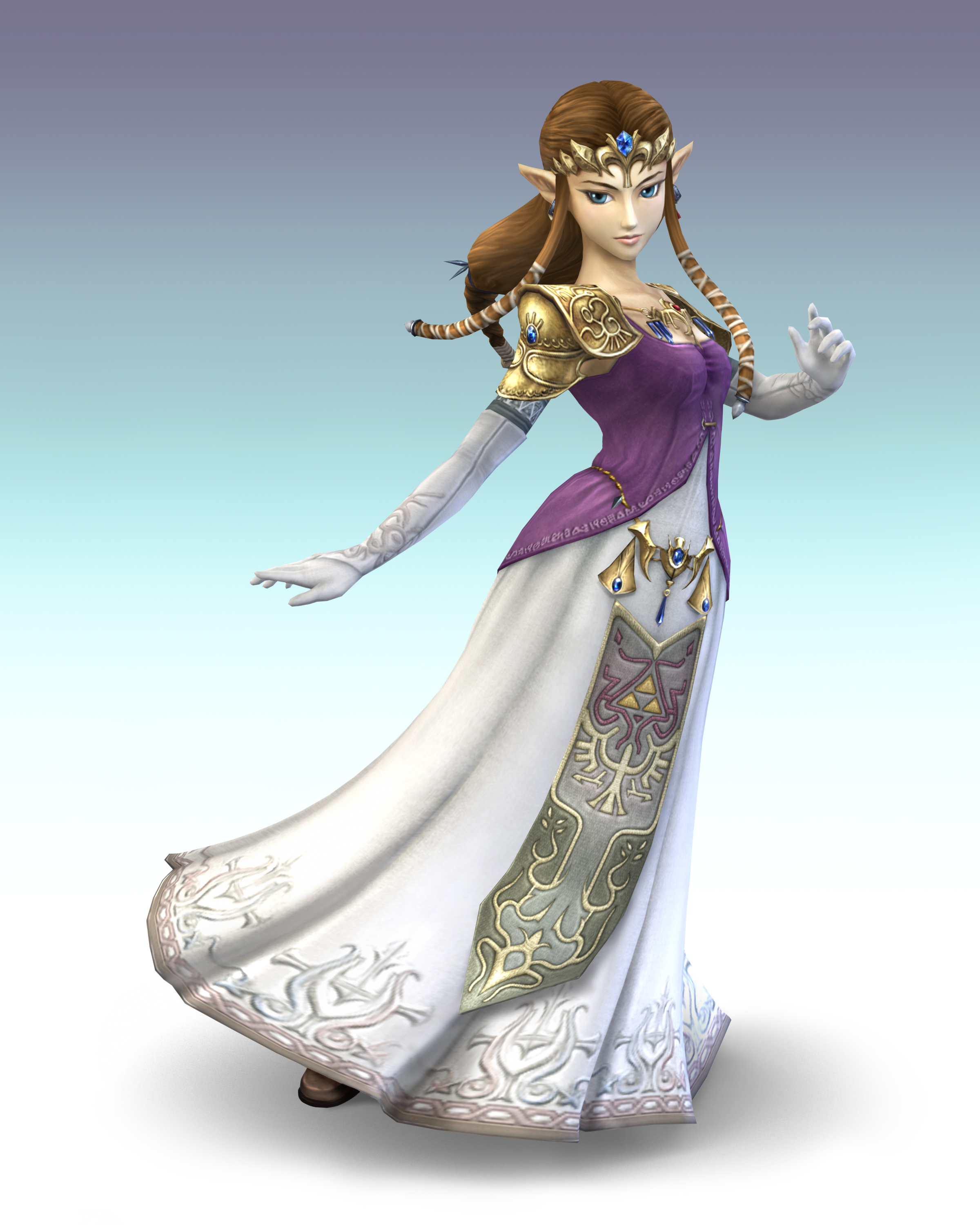

Princess Zelda:  Starting off as a plot device, Zelda has grown throughout the years into a capable leader, a trickster, a pirate, and a goddess.  Some of the evolution is simply due to space and programming improving. Other evolutions turn it from "A game about Link" to "The Legend of Zelda."  She, and no one else, knows Ganon is evil in OoT, she gathers other barrier maidens in "A Link to the Past", surrenders and is imprisoned rather than allowing her kingdom to be destroyed in "Twilight Princess" (Then sacrificing herself for Midna), and as the holder of the "Triforce of Wisdom" She's the wisest person in the game.
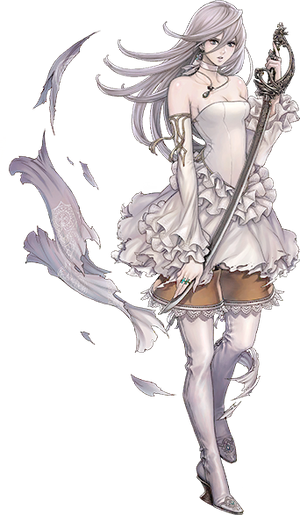
Calista: Polite, serious, and detesting corruption, Calista escapes the palace due to her uncle's controlling her, and understands politics, especially the ones around herself, very well.  She understands she has flaws, but also understands you don't have to do anything alone. (I need to play The Last Story)


Garnet: From Final Fantasy 9 (Another one I have to play.)  Garnet is discerning, noticing changes in her mother before anyone else does, forgiving, naive, and can both rule with honor and wisdom and can blend in with the common folk.  (Admittedly this does happen over the entire game, but it's there!)  She also realizes she can't do everything by herself and relies on others, though for her it's partly a coping mechanism. 


Merida: Yep, back to Merida.  A key part of the movie was Merida becoming like her mother, and how she (and her mother) by nature of being female had different, and just as valued, talents.  Like getting a bunch of Scottish warriors to stop brawling and listen. Merida had to learn to listen to other people, to understand where they are coming from, and there is a great dignity in activities other then fighting (such as sewing... look, it is actually more dramatic in the movie).  Plus, family is the most important thing a  person can have.  But even with that, the movie NEVER dismisses her love of archery, her horseback riding, and she still does not like corsets.  And that is fine.  She can still ride  ,walk with her elbows out, and she can hold a political conversation.  She's well rounded, and she is still a princess.


All of these girls are, in one way or another, feminine.  The PoH are, in fact, described as pure light.  But this doesn't make them weak or undeserving in any format.  Some are competent rulers (especially Jasmine in the source material and expanded in the TV show.  She ran Agrabah incredibly well). Others are hard workers who love everyone.  Others can cook. Others prefer to fight.  Even more can hold a court.   All are capable of sacrifice.  Their traits are feminine, not weak. And in fact, they are the stronger for it.  

Wednesday, April 17, 2013

Elizabeth and Booker's relationship and how other relationships need to be re evaluated. (Major Spoilers)

Elizabeth Colmstock is actually Anna, Booker's daughter.  However, we don't find that out (conclusively) until the last few minutes of the game. 

While it does provide a wonderful and interesting dynamic, especially considering their age and how they react to eachother for the first time, the game never provided any large romantic hints for each other. 
(Yeah, this never happened in game)

And when the game dropped the reveal,  some people were happy.  Others felt disgusted.  They had grown quite fond of the two as a couple and father/daughter pairings are generally agreed to not be a good thing.  Other people just said screw it and continued to think of them as a couple. 

However, the problem lies in the assumption.  If you have a male and female character together people are often to assume that the two are to be romantically linked unless they are early on announced as family.  

This is something we need to change.  (And we need more mother and daughter/son games but that is a different story) 

Platonic loving relationships (also known a Zucchini's, QPP, or Queer Platonic Partner) need to be more of a thing.  There is a glorious beauty in relationships that offer companionship without any romance.  They are also just as valid.

Let me direct you to Elementary.
Elementary charts the evolving relationship between a Sherlock Holmes and a (female) Joan Watson.  The creators have said, repeatedly, that the relationship will stay platonic, and as a result the series is an incredible breath of fresh air.  The two share a house, Joan has changed in the room with Sherlock (undercovers with his back turned for her privacy)  and the two argue over chores.  It could be romantic, but it's incredibly platonic and very sweet.  There are no kisses, some rare hugs, and a lot of calling eachother out on Sherlock's problematic behaviors and Joan's level of deduction (Both of which are improving.  Sherlock is behaving better and Joan is deducing more)  and we are never doubting how they care for each other.

Games need more of that.  We need to talk to characters without wanting romantic outcomes.  NieR has every one of his companions in love with him.  (Seriously, Emil is canonically Gay, Kaine is in love with him, and  Yonah is either his sister or his daughter depending on the version)  Cloud gets every girl (and Barrett) on a date with him.  Jack and Doctor Tenenbaum are not friends, just allies.  Rudy falls in love with Princess Cecilia.  The Kingdom Hearts trios are... complicated.


This turns relationships that could be complex one dimensional.  Romantic attachment leads only to an attempt at marriage or sex down the line.  When we view a relationship in only romantic or familial terms, we strip it of any extra nuances, or deny that a love can exist between friends.  These extra nuances are what make someone more fleshed out.  These relationships are NOT there because they because they "Have" to (I.E. family)  or out of hope or knowledge of some sort of payment (Romantic love)  these people are doing this because they want too. They are doing this out of love with no expectation of anything back.  And, this is happening on both sides.  Neither the boy nor the girl expect any sort of romantic repayment or familial devotion.  They are doing it because they have something in common and like each other in such a way all they want is this companionship. 

Think of what the writers can do with that!  At what point could it become too much?  Could one support the other at home or separated?  Would one die for the other?  There are so many untalked about subtleties in this kind of relationship.  How would Final Fantasy be different if the Tifa/Cloud/Aerith relationship didn't exist?  If Yonah was NieR's friend, not his sister or daughter? If Tenenbaum and Jack got to know each other better and decided to help each other for the relationship's own sake? (And not because of what Atlus could do to Rapture and the surface world) 

We need more of this kind of relationship.  We need to show how much love and trust can go into a non romantic relationship.  Dipper breaks up with an abusive boyfriend for Mabel, and Mabel saves Dipper when the abusive boyfriend fights back.  Joan knows enough to know that she MUST stick around when he's in danger of relapsing even when she's no longer employed as a sober companion, Sherlock knows parental approval for her Sobriety Companion career is important to her so he talks up her skills and results at a dinner with her parents. 

And Booker and Elizabeth? Well, he took down an entire civilization just to say her. She in turn went back to a place that was worse than death, sacrifices her sanity and a version of her existence to keep him alive and to fix it. It's because they are friends, partners, and it isn't until AFTER they are revealed to be family.  Not because of romantic love.

Tuesday, February 19, 2013

Fridging Women, part 1 (AKA what is Fridging? and why is it problematic?)

Oh, Fridging.  Oh, Sweet Cosmos Fridging.

Welcome to what is easily one of the most controversial ideas in "Gender Politics in Fridging."


Let's define some terms.

"Fridging" (Short for "Women in Refrigerators") Refers to an act where the villain kills, maims, depowers, or rapes someone close to the hero in order to break the hero's spirit and attempt to make the hero chase him.

It comes from a "Green Lantern" comic (1994) where Hal Jordan comes home to find his girlfriend killed by one of his villains, possibly dismembered, and stuffed into a fridge.


Gail Simone, a well respected writer for DC comics, read it and realized there was a very large pattern here, so she began to pull together a list of women in comics who are killed/maimed, etc by the villains in order to manipulate the male heroes.  (While it can happen to male heroes, they tend to come back with stronger powers.  Females tend to stay dead) 

One of the earliest examples in Comics is...

Gwen Stacy.
And there is really a long list, and it happens in all media, including video games.
Aerith?
Fridged:
Her death serves no purpose in the over game narrative OTHER then to motivate the characters (especially Cloud) in addition, it was not a self sacrifice (even if she did know that she would probably die) and she did not put up a fight.  It... happened.


And why is this problematic?  It turns a female character (who - as a character- should be fully fleshed out with her own ideas, dreams, skills, and emotional and character arc)  into someone who exists solely for the male character's arc. They exist only to propel the main character forward.  We don't know if Aerith wanted to be a teacher or a scientist, or a mom.  And even if we did find (Like we probably did with Gwen, I haven't read her comics) the simple act that she was killed off to promote Spider-man's arc NEGATES any dreams she may have had because she did not die on her own terms or for her own arc.  It was all for Spider-man's. 


Start looking over your old games.  See who dies and why.  Is it to promote their own story? Or someone else's? 

Wednesday, February 6, 2013

Bechdel Test part 2

Now, to follow up on Yesterday, you may be asking WHY this is so important.   Why should we care Catwoman and Poison Ivy are discussing plants?  Why does it matter that Terra throws a small fit asking Celes what love is and how Terra wants to know now?  How does it advance the story with all of the Femshep and Liara conversations in Mass Effect?

It's actually pretty freaking big.

Traditionally, if women are put into any media, it is to fill a "Token Female/romance" sub plot.  Women, in works written by men- which is most of it- they are only there to look pretty, fall in love, and to defuse accusations of sexism.

Now, that's not ALWAYS the case.  As I stated yesterday, this obviously does not apply to lesbian porn and there are great works where the use of women would be in congruent to the setting,

But, women are fully fleshed out people and pigeonholing this into the role of love interest (and that's it) opens up some VERY unpleasant implications.

That's why we need these as guidelines.  It is rare to see more then one women in the main group of anything. (The Avengers had three -one was a romantic interest but had other traits outside of it. The other two did not present romantic inclinations towards anyone- but none of them talked to each other) 

Men are allowed to talk to each other about issues other then women.  Heck, it's practically guaranteed that there will be more then one man in anything.  They will hold positions of power, they will be complex, multifaceted, and they will occasionally show emotions. 

The token girl will usually be a girlfriend, if we're lucky we'll also get a mother figure. But if those two talk, then it will automatically about the main male character.  It won't be about the girlfriend's job, or how they like to cook, the trip she took to Italy, or how she recently won the Pulitzer. 

Think about it?  While the number has gone up dramatically recently, it's still no where near enough what it needs to be.  For every episode of Once Upon a Time (Where there are about twice as many regular or reoccurring female characters to male characters and NONE are limited to just the girlfriend role.)  We also have a superbowl commercial for Audi that turns a teenage girl into something to fight over and celebrate when you get a black eye.
(Please don't click it, I don't want them to get the hits)

Women can not be reduced to motherhood, part of our function is to give life.  But they can be reduced to being one dimension, to only supporting a man, or to be property for the man to fight over.


The Bechdel test is just a stop gap.  But it's something that needs to be more present in games.  We need fully fleshed out female characters to help make this world, what ever world it is in the game, to feel fuller and more connected. The easiest way to do this is to have more then one main female character and have them talk about something other then the lead man.

Having a women take the place of the lead man and having her talk to other women about other things would be even better at times.

I'm not saying women should be every position in a game. That's just as bad.    But when what makes a game pass the Bechdel test is having a 30 second conversation about PLANTS, then something is up.  Something that drastically needs to be fixed. 


Tuesday, February 5, 2013

The Bechdel Test

The Bechdel Test is really more of a guideline, but it is quite important.    The rules are exactly as stated.  There are some alterations (some rules require the women to be named.  Others refuse men to be mentioned even in the abstract)  but as guidelines they are vital.

Why am I saying guidelines?  Because Lesbian porn automatically qualifies and (keeping with the movie theme) Movies that take place in World War II men's prison camps do not.  For example, Stahlag 17.  A BRILLIANT movie about a captured American soldier who is trying to find the German spy in his bunk area.  While Women appear, it is for a few comedy routines and are seen through a telescope. 

While games are a bit MORE likely to fit in the rules, it is still a bit hard to accomplish.

Final Fantasies?  Generally they accomplish it.  There are traditionally 3 female characters and with the saving of the world being something on the forefront of people's minds, they talk about getting it done. The most obvious examples are Fang and Vanille talking, since they talk a lot.  InFamous 2 has Kuo and Nix, and while they often talk about Cole, the also discuss powers and how to react to situations.  And when Shanoa takes the lead with Castlevania, she talks to all sorts of people about many different things, Dracula and her brother being just two options.


But, that's just three options.  Sly Cooper?  Nothing.  There's only one main Female Character (Carmelita Fox) and she's not playable until this game.  As it stands now, I don't know if she will talk to any of the female characters and - while she is quite devoted to the law- her arc also revolves around Sly Cooper himself. 

Kingdom Hearts 2 does have Selphie and Kairi talk to eachother briefly, but they only talk about Sora and Riku.  All other female characters do not cross paths with eachother, or if they do, they don't talk to eachother.

While Peach has her own Arcs in the Mario RPG series, independent of Mario and the other male characters, she generally does not talk to other female characters. 


This will need more research, but the next time you play, keep an eye out for this.  The standards are low, but how many pass does say a lot. 

Thursday, December 1, 2011

gender issues in games (part 1 - character design)

Okay, this isn't really going to be a series, just something I talk about when I feel like it.

I think today I'll explain why I'm talking about it.  Read this article first, not the comments.  And now you know why I'm thinking about it.

Gender is.... naturally complicated.  Men are usually the ones making the games (which is something else) so when it comes to character design, women are usually sexualized

While the men are... not.

I know there are unsexualized mature women (Jade from Beyond Good and Evil and Faith from Mirror's Edge for example)  and sexualized men (Tekken's Jin for example)  and, admittedly, Kaine's case is VERY complicated so she's getting her own post later.

But, by and large, this is the general trend.  Which is why women get very frustrated.

For me, at least, either turn down the fanservice on the female characters or turn it up on the males.  It's really frustrating when men are "complicated" and dressed reasonably but women are more "fanservice" and... that's it.  (Yes, I'll know I'll get called on for some characters such as Tifa, but let's just look at the general picture right now.  That is the exception, not the rule.) 

Some fanservice isn't that bad.  Lightning from Final Fantasy XIII has a belly button ring you can see, and that's it.  Othertimes, it's so overboard it may as well be parody, but it gets to be more then annoying when the first female character's show up, and it's a big breasted women wearing nothing but underwear, which has happened alot.  And then personality ends up just being somewhat one dimensional.  Admittedly, early non RPG games (and even some early RPG games) didn't really give anyone a personality so they are excused,  but since technology has developed, this has to change.

Again, nothing against fanservice, when done in moderation.  Girls do wear Midriff bearing shirts (which is why Jade isn't on my sexualized list)  and men do sometimes go around shirtless.... though unless they're exercising or in a naturally hot climate that just makes them look like jerks in my opinion.

Just make design practical (I can see a few small edits that could turn Lara's outfit from fanservice to actual climbing gear.... like extending the pants and shirt so she doesn't risk getting easily cut)   or give it a reason.  (Kaine)  and make the men a bit fanservicey too.  Again, in the realms of practicality.

And please, for the love of Cosmos, give the girls a real, complicated, personality, will ya? 

Then maybe we can look on these designs as something outdated from yesteryear, rather then something we do need to fix now.

So, can I ask a favor?  May I get a list of your top video game characters, one for each category.
1) Sexualized male
2) Sexualized female
3) Unsexualized male
4) Unsexualized female

Thank you for reading this post.  I'll try to tackle other gender issues later, and maybe I'll rewrite this post some day.